作者: G0dspeed
Get a list of Open Ports
LINUX
netstat -lntu
as replied by @askmish will give you list of services running on your system on tcp and udp ports where
- -l = only services which are listening on some port
- -n = show port number, don’t try to resolve the service name
- -t = tcp ports
- -u = udp ports
- -p = name of the program
You don’t need the ‘p’ parameter as you’re only interested in getting which ports are free and not which program is running on it.
This only shows which ports on your system are used up, though. This doesn’t tell you the status of your network e.g. if you’re behind NAT and you want some services to be accessible from outside. Or if the firewall is blocking the port for outside visitors. In that case, nmap comes to the rescue. WARNING: Use nmap only on networks which are under your control. Also, there are firewall rules which can block nmap pings, you’ll have to fiddle around with options to get correct results.
2016.09.27 更新
netstat -peanut 用这个参数更可以列出是哪个程序在占用哪个端口
Windows
netstat -ano 可以直接列出PID,然后到任务管理器里面可以根据PID查看是哪个程序。
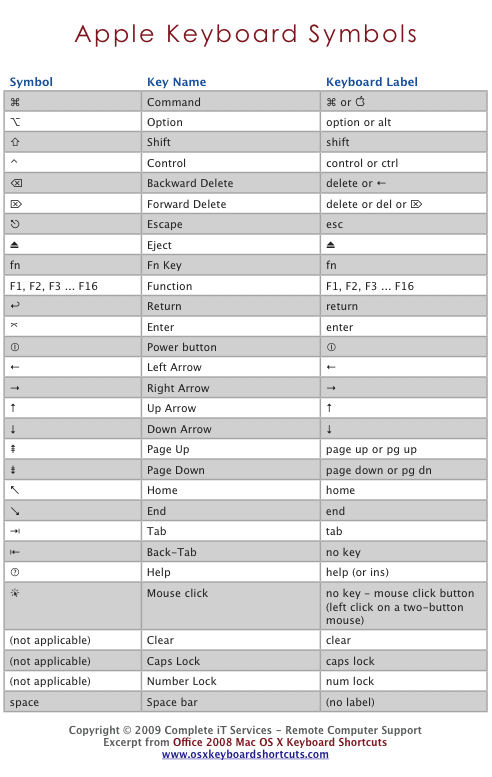
键盘上所有符号的英文表述
| Key/Symbol | Explanation |
| Windows | PC keyboards have a Windows key that looks like a four-pane window |
| Command | Apple Mac computers have a command key. |
| Menu | PC keyboards also have a Menu key that looks like an cursor pointing to a menu. |
| Esc | Esc (Escape) key |
| F1 – F12 | Information about the F1 through F12 keyboard keys. |
| F13 – F24 | Information about the F13 through F24 keyboard keys. |
| Tab | Tab key |
| Caps lock | Caps lock key |
| Shift | Shift key |
| Ctrl | Ctrl (Control) key |
| Fn | Fn (Function) key |
| Alt | Alt (Alternate) key (PC Only; Mac users have Option key) |
| Spacebar | Spacebar key |
| Arrows | Up, Down, Left, Right Arrow keys |
| Back Space | Back space (or Backspace) key |
| Delete | Delete or Del key |
| Enter | Enter key |
| Prt Scrn | Print screen key |
| Scroll lock | Scroll lock key |
| Pause | Pause key |
| Break | Break key |
| Insert | Insert key |
| Home | Home key |
| Page up | Page up or pg up key |
| Page down | Page down or pg dn key |
| End | End key |
| Num Lock | Num Lock key |
| ~ | Tilde |
| ` | Acute, Back quote, grave, grave accent, left quote, open quote, or a push |
| ! | Exclamation mark, Exclamation point, or Bang |
| @ | Ampersat, Arobase, Asperand, At, or At symbol |
| # | Octothorpe, Number, Pound, sharp, or Hash |
| £ | Pounds Sterling or Pound symbol |
| € | Euro |
| $ | Dollar sign or generic currency |
| ¢ | Cent sign |
| ¥ | Chinese/Japenese Yuan |
| § | Micro or Section |
| % | Percent |
| ° | Degree |
| ^ | Caret or Circumflex |
| & | Ampersand, Epershand, or And |
| * | Asterisk and sometimes referred to as star. |
| ( | Open parenthesis |
| ) | Close parenthesis |
| – | Hyphen, Minus or Dash |
| _ | Underscore |
| + | Plus |
| = | Equal |
| { | Open Brace, squiggly brackets, or curly bracket |
| } | Close Brace, squiggly brackets, or curly bracket |
| [ | Open bracket |
| ] | Closed bracket |
| | | Pipe, Or, or Vertical bar |
| \ | Backslash or Reverse Solidus |
| / | Forward slash, Solidus, Virgule, or Whack |
| : | Colon |
| ; | Semicolon |
| “ | Quote, Quotation mark, or Inverted commas |
| ‘ | Apostrophe or Single Quote |
| < | Less Than or Angle brackets |
| > | Greater Than or Angle brackets |
| , | Comma |
| . | Period, dot or Full Stop |
| ? | Question Mark |
Ten Tips for Negotiating in 2016
The ability to negotiate successfully in today’s turbulent business climate can make the difference between success and failure. With this in mind, Ed has reevaluated his list of top ten negotiation tips. Here are Ed Brodow’s Ten Tips for Successful Negotiating updated for the year 2016:
1. Don’t be afraid to ask for what you want. Successful negotiators are assertive and challenge everything – they know that everything is negotiable. I call this negotiation consciousness. Negotiation consciousness is what makes the difference between negotiators and everybody else on the planet.
Being assertive means asking for what you want and refusing to take NO for an answer. Practice expressing your feelings without anxiety or anger. Let people know what you want in a non-threatening way. Practice ‘I’ statements. For example, instead of saying, “You shouldn’t do that,” try substituting, “I don’t feel comfortable when you do that.”
Note that there is a difference between being assertive and being aggressive. You are assertive when you take care of your own interests while maintaining respect for the interests of others. When you see to your own interests with a lack of regard for other people’s interests, you are aggressive. Being assertive is part of negotiation consciousness.
“Challenge” means not taking things at face value. It means thinking for yourself. You must be able to make up your own mind, as opposed to believing everything you are told. On a practical level, this means you have the right to question the asking price of that new car. It also means you have an obligation to question everything you read in the newspaper or hear on CNN. You cannot negotiate unless you are willing to challenge the validity of the opposing position.继续阅读
在VMWARE PLAYER中体验UEFI
现在的笔记本、台式机,都不用BIOS,改成用UEFI了。
想要体验下UEFI但又不想在搞砸自己的系统咋办?
当然是在免费的VMWARE PLAYER里面使用UEFI了!
但是UEFI默认在VMWARE PLAYER里面是关闭的。这个时候就需要使用这个OpenSource的工具了:
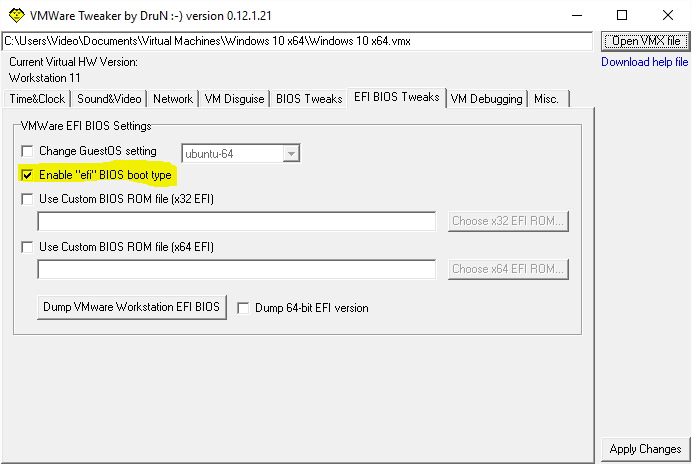
打开这个Enable “efi” BIOS boot type,你就可以体验UEFI了。
替代Ghost的备份软件
现在磁盘分区升级成GPT,主板引导也变成EFI。虽然可以用Ghost 11.5,但是感觉不大好用…
研究了一下,推荐Macrium Reflect。简单易用的操作界面,备份、克隆速度也不错!
关键还是免费软件~ 🙂
http://www.macrium.com/reflectfree.aspx
这下满意了吧?
WordPress更新需要输入FTP账户?
最近在Ubuntu上安装LAMP,并假设Wordpress。发现权限无论怎么设,除非设置为执行Apache的用户,才能避开这个问题。
弄了半天,最后发现在wp-config.php里面加入这句话可以解决这个问题:
define('FS_METHOD', 'direct');
如何在Windows10安装以后打开AHCI
在安装完Win10以后,才发现居然没有打开硬盘的AHCI模式。怎么办?
别急,其实很简单。不用重装Win10的。照下面步骤来就行。
- 管理员权限打开命令提示符
- 使用这个命令打开启动自动进入安全模式:
bcdedit /set {current} safeboot minimal - 重启电脑进入BIOS
- 更改硬盘工作模式为AHCI,保存退出
- Win10会以安全模式启动
- 在安全模式下用管理员权限打开命令提示符窗口
- 执行如下命令关闭启动自动进入安全模式
bcdedit /deletevalue {current} safeboot - 重启电脑以正常模式进入Win10
- Duang~成功!
能从让你从硬盘安装系统的小工具
Linux下遍历查找某的文件包含某个关键字的命令
如下命令
grep -rnw '/path/to/somewhere/' -e "pattern"
-r 或者 -R 为递归查找, -n 是行号 -w 为要求全匹配. -l (小写L) 参数可以只列出文件名.
除此以外, –exclude 或者 –include 参数可以提供更有效的查找。比如:
grep --include=\*.{c,h} -rnw '/path/to/somewhere/' -e "pattern"
这个可以查找扩展名为.c或者.h的文件. –exclude的用法也类似:
grep --exclude=*.o -rnw '/path/to/somewhere/' -e "pattern"
上面这行命令在搜索中会排除扩展名为.0的文件。和包含/不包含文件一样,目录也可以使用 –exclude-dir 和 –include-dir 参数。 比如下面列出怎么使用 –exclude-dir:
grep --exclude-dir={dir1,dir2,*.dst} -rnw '/path/to/somewhere/' -e "pattern"
如果单是遍历查找文件的话可以用
find . -name '*.xml'
如果想遍历删除某种类型的文件的话,可以用
find . -name '*.xml' -type f -delete